

 July 11, 2026
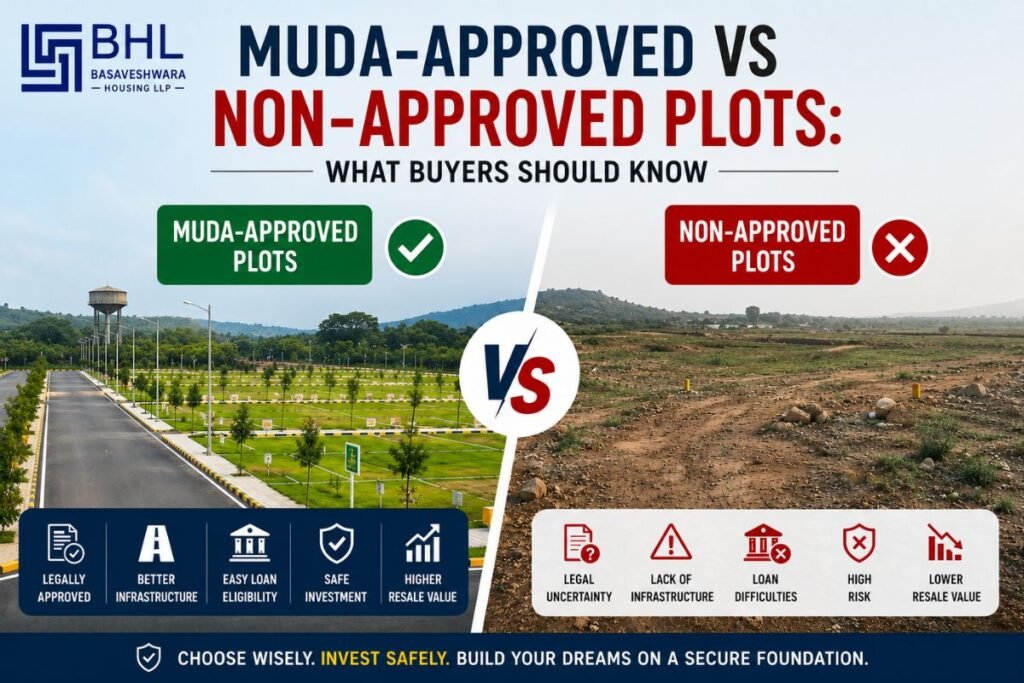
Buying a residential plot is one of the most important financial decisions many individuals and families make in their lifetime. For some buyers, land represents the foundation of a future dream home. For others, it is a long-term investment intended to create financial security and future value. Whatever the purpose, choosing the right plot requires more than simply finding a good location or an attractive price.
One of the most important factors that every property buyer in Mysuru should understand is the difference between a MUDA-approved plot and a non-approved plot.
At first glance, two plots may appear very similar. They may be located in the same developing area, have similar dimensions, and even be offered at competitive prices. However, the approval status of the layout can significantly affect the legal, planning, construction, financing, and resale aspects of the property.
Understanding these differences can help buyers ask the right questions, verify important documents, and make a more informed property investment decision.
What Is a MUDA-Approved Plot?
MUDA traditionally refers to the Mysuru Urban Development Authority, the planning and development authority associated with Mysuru’s urban development. In 2025, the authority was reorganised and renamed the Mysuru Development Authority, or MDA. However, the term “MUDA-approved plot” continues to be widely used in the Mysuru real estate market.
A MUDA-approved plot generally refers to a site located within a layout that has received the required layout sanction from the competent planning authority for development according to an approved plan.
Layout approval is not simply about dividing a large piece of land into smaller sites. Planned layout development considers important aspects such as road alignment, plot dimensions, drainage, water supply arrangements, lighting and other planning requirements. Under the legal framework governing Mysuru’s planning authority, forming a layout for building purposes requires express written sanction from the authority, and layout applications are expected to include details relating to streets and infrastructure arrangements.
Therefore, when buyers hear the term “MUDA-approved layout,” they should understand that approval relates to the sanctioned development plan and should still verify the specific project documents, plot details and title records before completing a purchase.
What Is a Non-Approved Plot?
A non-approved plot generally refers to a plot formed or marketed without the required layout approval from the competent planning authority.
In some cases, agricultural or other larger parcels of land may be divided into smaller plots and offered to buyers without completing all the required planning and layout approval procedures. Such plots may be advertised at comparatively lower prices, making them attractive to buyers who are primarily focused on affordability.
However, a lower purchase price should not be the only factor considered when buying land.
A plot may physically exist on the ground, have boundary markings and even be accessible by a road, but that does not automatically mean the layout has received statutory approval. Buyers should avoid assuming that registration of a document alone confirms layout approval or guarantees that every planning requirement has been satisfied.
The legal title to the land, land-use status, layout approval, sanctioned plan and property registration are related but distinct aspects of a property transaction. Each must be independently examined.
Why Are Non-Approved Plots Sometimes Cheaper?
Price is one of the main reasons buyers consider non-approved plots.
A non-approved plot may be offered at a lower rate compared with plots in sanctioned layouts. This price difference can be attractive, especially for first-time land buyers or families working within a limited budget.
However, buyers should ask an important question:
Why is the plot cheaper?
The lower price may reflect differences in approval status, infrastructure development, documentation, location or market demand.
A lower initial investment does not automatically mean better value.
If a buyer later faces difficulties related to construction permissions, financing, documentation or resale, the overall cost and inconvenience may outweigh the initial price benefit.
Therefore, property buyers should evaluate the complete value of the investment rather than comparing plots only on a price-per-square-foot basis.
Does Registration Mean a Plot Is MUDA Approved?
This is one of the most important questions buyers should understand.
Property registration and layout approval are not the same thing.
Registration records a property transaction through the applicable registration process. Layout approval relates to the planning authority’s sanction for the development of the layout.
Therefore, buyers should not assume that a registered sale deed automatically proves that a plot is part of a MUDA-approved layout.
Before purchasing a plot, ask the seller or developer to provide the layout approval documents and sanctioned layout plan. Verify that the plot being offered matches the details shown in the relevant approved documents.
When in doubt, seek independent legal advice.
Is Every MUDA-Approved Plot Completely Risk-Free?
No property investment should be considered automatically risk-free simply because one approval is available.
MUDA or planning authority approval is an important factor, but buyers must still examine the complete legal and property documentation.
For example, buyers should verify the title history, encumbrances, ownership rights, survey details, boundaries and the seller’s legal authority to transfer the property.
The actual plot should also be compared with the sanctioned layout plan.
Buyers should conduct a physical site visit and verify access roads, development progress, surrounding infrastructure and neighbourhood conditions.
A comprehensive approach to property verification is always better than relying on a single document or marketing claim.
Why Location and Approval Should Be Considered Together
Approval is extremely important, but location also plays a major role in property investment.
A well-documented plot in a developing area with good connectivity and future growth potential may offer significant long-term advantages.
When evaluating a residential plot in and around Mysuru, buyers should consider access to major roads, employment areas, educational institutions, healthcare facilities, commercial centres and developing residential neighbourhoods.
MUDA-Approved Plots: A Better Choice for Informed Buyers
For buyers seeking greater clarity regarding planning approval, MUDA-approved layouts can be an important option to consider.
Approved layouts provide a sanctioned planning framework and allow buyers to examine the proposed development against official layout documents.
This can be particularly important for families planning to build a dream home, first-time plot buyers and investors looking at long-term property ownership.
However, buyers should always remember one principle:
Verify before you invest.
Never purchase land based only on attractive advertisements, verbal promises or unusually low prices.
Ask questions.
Examine the documents.
Visit the property.
Compare the site with the sanctioned layout.
Understand the approval status.
Consult an independent legal professional.
A careful property decision made today can help protect your investment for years to come.
Choose Transparency. Choose Planned Development. Choose Wisely.
At Basaveshwara Housing LLP, we understand that purchasing a residential plot is more than a property transaction. It is an important step towards building a home, creating a secure future and achieving a long-term financial goal.
Our focus is on offering residential plot opportunities with an emphasis on transparency, planned development and customer guidance.
We believe that every buyer deserves clear project information and the opportunity to understand the property before making a purchase decision.
Whether you are searching for a residential plot for your dream home or exploring land as a long-term investment opportunity in Mysuru, making an informed decision is essential.
Explore residential plot opportunities with Basaveshwara Housing LLP and take the next step towards owning land with greater confidence.
Your Dream Plot. Your Future. Your Trusted Property Journey.